Choosing a commercial snow removal company is not really a decision about snow. It is a decision about liability, operations, and who is accountable when a storm hits your Denver property at 4 a.m. Pick the wrong contractor and an unplowed lot is the least of your worries: you are exposed to slip-and-fall claims, blocked access, and lost business. This guide walks through exactly how to evaluate providers so you can sign with confidence. If you are researching commercial snow removal for your property, use these criteria to separate the professionals from the pretenders.
Why the Contractor You Pick Matters More Than the Price
It is tempting to sort bids by price and take the lowest one. In commercial snow management, that instinct is expensive. The cheapest quote is often the one that skips proper insurance, owns too little equipment, and keeps no records, which means the savings evaporate the moment something goes wrong. As a property owner or manager, you are responsible for keeping your premises reasonably safe in winter, and your contractor is the partner who either protects you from that liability or leaves you holding it. Think of this as a risk-management decision first and a line-item second.
Questions to Ask Before You Sign
A professional contractor will have clear, confident answers to all of these. Hesitation on any one is a signal:
- Are you licensed, insured, and certified, and can you provide proof?
- What are your general liability, auto, and workers’ compensation limits?
- Will you name our property or management company as an additional insured?
- What is your guaranteed response time, in writing, and how is it measured?
- How many pieces of equipment do you own and maintain?
- What documentation will we receive after each storm?
- Can you provide references from properties like ours?
Notice how many of these have nothing to do with price. That is the point.
Response Time and What “24/7” Actually Means
Every snow company advertises 24/7 service. Fewer can explain what it means. Ask them to define it. True around-the-clock coverage means active storm monitoring, crews on standby, and a real dispatch process, rather than a phone number someone might answer. Industry practice is for plowing to begin within roughly one to two hours of a trigger-depth accumulation, with sidewalks and entrances cleared before your business opens. Get the specific response-time commitment in the contract, along with how it is measured and what happens if it is missed. A vague promise is worthless at 5 a.m. during a blizzard.
Fleet Size and Why It Determines Your Service Window
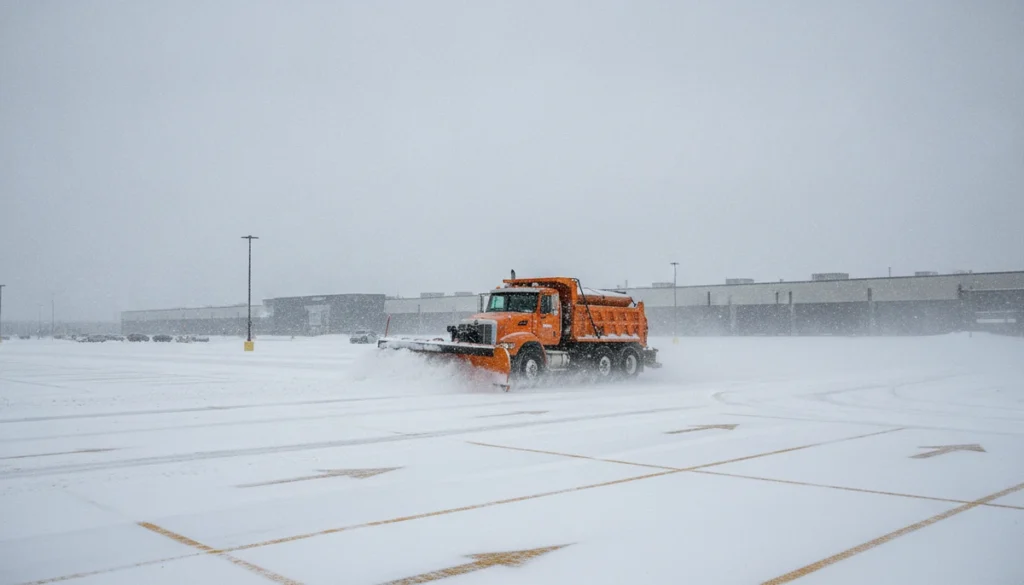
This is the criterion most buyers underestimate. In a normal week, almost any contractor can clear your lot. The test is a major regional storm, when every client needs service at the same time. That is when fleet size decides who gets cleared first and who waits. A provider with a large, owned, and well-maintained fleet, plus backup equipment staged and ready, can hold to its service windows across many properties at once. A small operation running a handful of trucks may be fine for a single lot but gets stretched dangerously thin the moment a big storm rolls across the Front Range. Ask how many trucks, plows, skid steers, and de-icing spreaders they own outright, not what they can rent after the snow starts falling.
Single-Site vs Multi-Site Coordination
If you manage more than one property, coordination becomes its own criterion. You need consistent service across every location, a single point of contact, and a dispatch system that can push crews to all of your sites without any one of them falling through the cracks. Ask how the provider assigns crews across a portfolio, how they keep service consistent from site to site, and who you call when you need answers during an event. A contractor built for single small lots often cannot scale to a portfolio, and the gap shows up on your worst weather day.
Insurance, Liability, and Slip-and-Fall Exposure
Slip-and-fall is the single biggest liability in commercial snow management, and it is where an underinsured contractor can put your business at risk. At a minimum, confirm your contractor carries commercial general liability insurance, typically $1 million per occurrence and $2 million aggregate, along with commercial auto coverage for their fleet and workers’ compensation for their crews. If an uninsured worker is hurt on your property, that liability can land on you. Always request a certificate of insurance that names you as an additional insured, and verify the coverage directly with the carrier rather than taking a contractor’s word for it. Industry certifications through organizations like the Snow and Ice Management Association (SIMA) or the ASCA, and credentials such as the Certified Snow Professional (CSP), are strong signals that a provider takes standards and risk seriously.
Documentation: What You Should Expect After Every Storm
Here is the detail that separates a true partner from a plow-and-go operation: documentation. Slip-and-fall claims are often filed months, even years, after the incident. When that happens, your contractor’s service records are your primary legal defense. After every storm, you should receive timestamped logs showing arrival and departure times, the services performed, the de-icing materials applied, and the weather conditions, ideally backed by photos of the cleared property. If a contractor cannot produce a clear, time-stamped record, and photo evidence, for the exact date in question, your defense in a claim gets much harder. Detailed photo reporting is not a nice-to-have; it is the paper trail that protects your property.
Red Flags
Finally, watch for the warning signs that a contractor is not built for commercial work:
- A verbal or handshake agreement instead of a written contract with defined terms
- Hesitation or excuses when you ask for a certificate of insurance
- An inability to explain how they monitor storms and dispatch crews
- No post-storm documentation, service logs, or photos
- Plans to rent or source equipment only after a storm begins
- Vague, unwritten response-time promises
- A bid far below the others, which usually means insurance or documentation is being skipped
Any one of these should give you pause. Two or more, and you should keep looking. The right commercial snow removal contractor in Denver will meet every criterion in this guide without flinching. Lightning Mobile Services has handled commercial exterior maintenance across the Denver metro area for more than 40 years. When you are ready to compare, learn more about our team or get in touch to talk through your property’s needs.