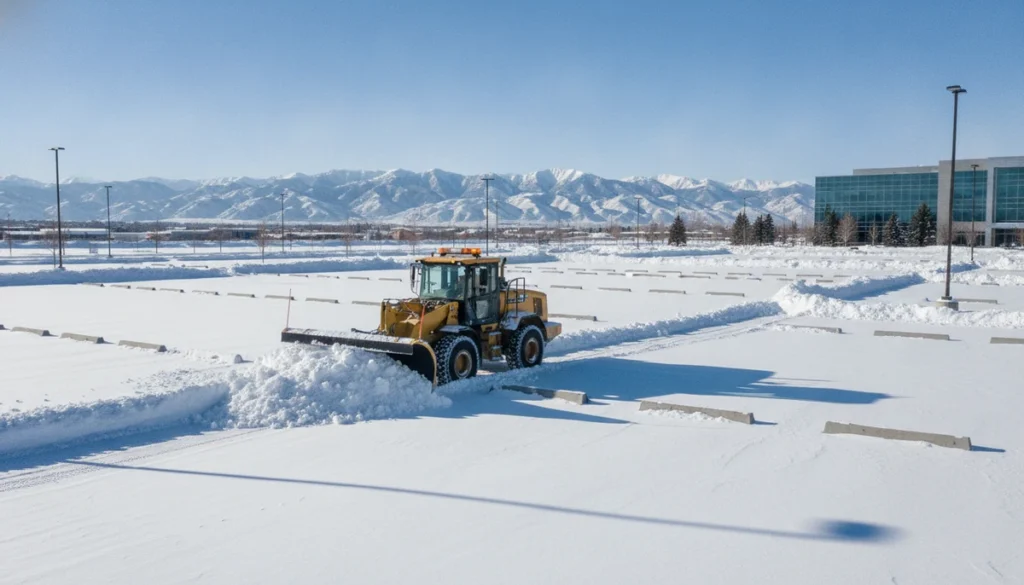
If you manage a commercial property in the Denver metro, snow removal is a line item you have to budget for, and getting a straight answer on cost can be surprisingly hard. Most companies dodge the question until they have you on the phone. We would rather give you real numbers. Below are the pricing models used across the industry, the market ranges that go with them, and the factors that move your specific cost up or down. Every property is different, so the only truly accurate number comes from a walkthrough, but by the end of this page you will know enough to build a realistic winter budget and compare bids with confidence.
A quick note on the figures here: these are general Denver area market ranges to help you plan, not a Lightning Mobile price list. Your actual quote depends on your property.
What Drives the Price of Commercial Snow Removal
Before the dollar figures, it helps to understand what you are actually paying for. Commercial snow removal pricing in Denver comes down to a handful of variables:
- The size of the area to be cleared. More square footage of lots, drives, and walkways means more time, equipment, and material.
- How the work is billed. Per event, time and material, and seasonal contracts spread cost and risk very differently, which we break down below.
- Snowfall frequency and depth. A heavy Front Range winter with frequent storms costs more to service than a mild one, especially under per event and time and material billing.
- Deicing and ice control. Salt and deicer are usually priced separately from plowing, and Denver’s freeze-thaw cycles make ice management a real part of the budget.
- Response time and service level requirements. A property that must be cleared before a 7 a.m. open, or kept continuously clear during a storm, takes more resources than one with a flexible window.
Per Event Pricing: How It Works and Who It Suits
Per event pricing, sometimes called per push, charges you each time the crew comes out to clear your property during or after a storm. It is the most direct way to pay: you are billed for the snow that actually falls.
As a general market range, per event plowing runs roughly $300 to $750 or more per push for a small to mid-size commercial lot, and $1,500+ per event for a large lot. Deeper snow often means multiple passes in a single storm, so a big storm can trigger more than one charge. Deicing is typically billed on top.
Per event billing suits properties in areas with lighter or unpredictable snowfall, and managers who would rather pay only for service they actually receive. The tradeoff is budget uncertainty: a heavy winter with frequent storms can add up quickly, and in a snowy stretch your costs are hard to predict in advance.
Time and Material Billing
Time and material billing charges for the actual hours worked plus the materials used, such as salt and de-icer. Rather than a flat per-visit fee, you pay for equipment and crew time on your property.
Market hourly rates generally run about $150 to $300 per hour depending on the equipment, with larger machines like loaders and skid steers at the higher end, often $200 to $300 per hour. Deicing materials are billed separately, commonly around $250 to $500 per application depending on the area treated.
This model fits large, complex, or variable properties where the work required can swing a lot from storm to storm. It is transparent, you see exactly what you paid for, but like per event billing, the total varies with the weather, so it takes a little more active budgeting.
Seasonal Flat Rate Contracts
A seasonal flat rate contract charges one set price for the entire winter, no matter how many times it snows. The cost is based on your property and the expected number and severity of storms in a typical Denver season.
Seasonal commercial contracts commonly range from roughly $7,500 to $100,000 or more for the season, driven mostly by lot size and the scope of service. A small professional building sits near the bottom of that range; a large retail center or multi-building property sits well above it.
The advantage is predictability. You know your winter snow budget up front, the cost does not spike in a heavy year, and the provider is motivated to service your property promptly because the price is fixed. For property managers who need a clean, locked-in number for their annual budget, which is most of them, this is usually the most practical model. It is also the one most Denver commercial clients choose for exactly that reason.
How Property Size, Surface Type, and Access Affect Cost
Two properties with the same square footage can still price out very differently. Three factors explain most of the gap:
- Property size. This is the biggest driver. More pavement to clear means more time, more passes, and more deicing material, and it scales every pricing model up.
- Surface type. Smooth, well-maintained asphalt clears faster than cracked pavement, gravel, or decorative surfaces like pavers, which take more care and time. Concrete walkways and stairs add hand labor time on top of plowing.
- Access and obstacles. A wide-open lot is quick to plow. Tight corners, parking islands, curbs, loading docks, bollards, tiered lots, and cars left overnight all slow the crew down and raise the cost. Where the cleared snow can be piled on the property matters too; if it has to be hauled off-site, that is an added expense.
What Is Usually Not Included
A plowing price often covers less than people assume. Read any quote closely for whether these are included or billed separately:
- Deicing and salting. Ice control is usually a separate line item from plowing, not baked into the per push or seasonal price.
- Sidewalk and entrance clearing. Hand clearing walkways, entries, and stairs is frequently priced apart from clearing the lot.
- Snow hauling and off-site removal. When there is nowhere left to pile snow, hauling it away costs extra and requires additional equipment.
- Deep snow or multiple visit surcharges. Some per event agreements add charges above a certain depth or for repeat visits during a single large storm.
None of these are hidden fees when they are spelled out up front. The problem is a quote that stays silent on them, which brings us to comparing bids.
How to Compare Two Bids Fairly
The lowest number on paper does not always mean the lowest cost once winter is over. To compare two commercial snow removal bids fairly, line them up on the same terms:
- Confirm both use the same billing model, you cannot fairly compare a per event bid to a seasonal flat rate without estimating a typical season.
- Check what triggers service: at what snow depth does the crew show up, and is that automatic or do you have to call?
- Confirm whether deicing, sidewalks, and hauling are included or extra in each bid.
- Compare response-time commitments and service levels, not price alone.
- Ask about equipment, crew size, and insurance, which tell you whether the company can actually deliver in a big storm.
A detailed bid that spells all of this out is usually more trustworthy than a lower number with no detail behind it. For more on vetting a provider beyond price, see our guide on how to choose a commercial snow removal company.
Get a Quote for Your Property
The ranges on this page will help you build a realistic winter budget, but the only accurate number is one based on your actual property. Lightning Mobile has kept Denver commercial properties clear and safe for around 40 years, and we believe in transparent pricing with no surprise bills. We will walk your property, understand your access and service needs, and recommend the billing model, per-event or a seasonal contract, that fits your budget and your winter. Learn more about our commercial snow removal and ice control services, or contact us at (720) 456-9191 for a quote built around your property.
Frequently Asked Questions
How much does commercial snow removal cost in Denver?
It depends on your property and billing model, but as general market ranges, per event plowing runs about $300 to $750+ per push for smaller lots and $1,500+ for large ones, hourly work runs about $150 to $300 per hour, and seasonal contracts commonly range from about $7,500 to $100,000+ for the winter. A property walkthrough gives you an exact number.
Is a seasonal contract or per event pricing better?
Seasonal contracts give you a predictable, locked-in budget regardless of how much it snows, which is why most commercial property managers prefer them. Per event pricing means you only pay when it snows, which can cost less in a mild winter but is harder to budget in a heavy one.
Is deicing included in snow removal pricing?
Usually not. Salt and deicing are typically billed separately from plowing. Always confirm whether ice control is included in a quote, especially in Denver, where freeze-thaw cycles make ice management a regular part of winter.
Why do two snow removal quotes vary so much?
Often because they are not quoting the same thing. Differences in billing model, service trigger depth, response time, and whether deicing, sidewalks, and hauling are included can make one bid look cheaper while actually covering less. Compare them on the same terms.