
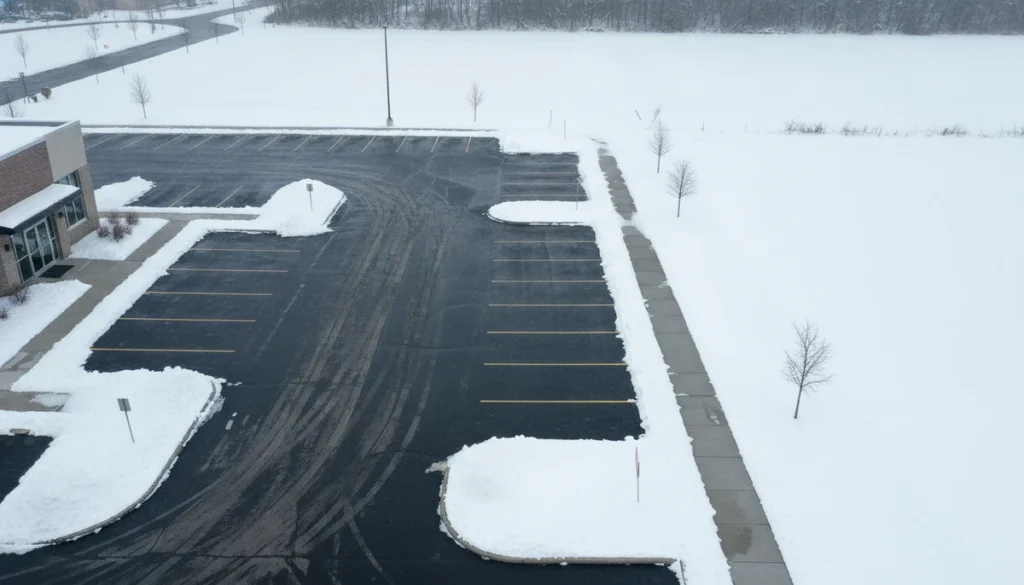
When the first storm of the season hits, a lot of property managers find themselves asking a question they wish they had settled in September: who is actually responsible for clearing the snow, the landlord or the tenant? It is a fair question, and the honest answer is that it depends, mostly on the lease. But the deeper issue underneath it is liability, and that is what keeps property managers up at night. Here is a practical look at how snow responsibility is typically allocated at commercial properties, where the real risk lies, and what you can do to protect your property and everyone on it.
This article is general information for property managers and landlords, not legal advice. For questions about a specific lease or claim, consult a qualified attorney.
Who Is Legally Responsible: Landlord, Tenant, or Both
There is no single rule that says the landlord or the tenant always owns snow removal at a commercial property. In most cases, responsibility is set by the lease, not by a default assumption, which is exactly why the answer varies from property to property and even from tenant to tenant in the same building. Broadly, it tends to break down like this: at a single-tenant property, the lease often assigns snow removal to the tenant, since they control the entire site. At a multi-tenant property, the landlord or property manager usually handles the shared areas, with the cost passed through to tenants. The key point is that the lease controls, so the first place to look is always the lease itself.
What Commercial Leases Typically Say
Commercial leases allocate maintenance responsibilities like snow removal in fairly predictable ways, depending on the lease type:
- Triple net (NNN) leases. These shift most operating and maintenance costs to the tenant. In a single tenant NNN lease, snow removal is frequently the tenant’s responsibility. In a multi-tenant setting, snow for common areas is typically arranged by the landlord and billed back to tenants.
- Gross or full service leases. Here the landlord generally keeps responsibility for maintenance, including snow removal, and builds the cost into the rent.
- Modified leases. Many leases fall somewhere in between and spell out specific duties. This is where you find language assigning the parking lot, sidewalks, and entrances to one party or another.
The practical takeaway: read the lease closely and look specifically for who is responsible for the lot, the sidewalks, and the entrances, because those are not always assigned to the same party.
Common Area Maintenance and Snow
At multi-tenant properties, snow removal of shared spaces usually falls under common area maintenance, or CAM. Common areas, the shared parking lot, sidewalks, entrances, and walkways, are generally maintained by the landlord or property manager, who arranges the snow removal and then allocates the cost among tenants, often pro rata by square footage, through their CAM charges.
For a property manager, this is usually the cleanest arrangement, because it keeps the shared areas under one consistent standard rather than leaving each tenant to clear their own patch. It also means you, not the individual tenants, are typically arranging and overseeing snow service for the parts of the property where the most people walk.
Slip-and-Fall Liability in Colorado
This is the part that actually worries property managers, and for good reason. When someone slips on snow or ice at a commercial property, the question of who is liable does not always track neatly with who the lease said should clear it. In Colorado, as in most states, property owners and those who control a property owe a duty to exercise reasonable care to keep it safe for those who come onto it. That duty is why unaddressed snow and ice is such a risk.
In practice, an injured person often names everyone connected to the property, the owner, the property manager, and sometimes the tenant, and lets the parties sort out responsibility from there. That means a clear lease, a clear division of duties, and proof that snow and ice were actually being handled all matter enormously. Clarity and documentation are your best protection, which is the thread running through the rest of this article.
Why Ambiguity in the Lease Costs Everyone
The worst-case scenario is not a lease that assigns snow removal to the other party. It is a lease that is vague or silent about it. When responsibility is unclear, each side tends to assume the other has it handled, and the result is a lot that goes unaddressed, or sidewalks that get missed because everyone thinks it’s someone else’s job.
That gap is where people get hurt, and claims get filed, and it is also where the finger-pointing starts after the fact. Ambiguity does not reduce anyone’s risk; it increases everyone’s. The time to resolve it is before the season, by ensuring your leases clearly state who clears what and that the actual coverage on the ground matches what the leases say.
How a Single Contractor Across the Property Reduces Risk
One of the most effective things a property manager can control is how the work is actually covered. When snow removal is split across multiple parties and multiple small vendors, seams appear: the lot is cleared, but the sidewalk is not, or the entrance is done but the back walkway is missed, because each piece was somebody else’s responsibility. Those seams are exactly where someone slips. Using a single, reliable contractor to handle the entire property, lot, sidewalks, entrances, and walkways together closes those gaps.
You get one consistent standard across the whole site, one point of accountability, and one source for the service records you may need later. It is simpler to manage, and it reduces the risk of a missed area. This is a large part of why property managers across Denver rely on Lightning Mobile for commercial snow removal and ice control across their entire property rather than piecing it together.
What to Document After Every Storm
If a claim is ever filed, the question will be whether the property was being maintained with reasonable care, and the answer lives in your records. Good documentation is one of the simplest and most powerful protections a property manager has. After every storm, you want a record of:
- The date and time the crew serviced the property
- What was done: areas plowed, shoveled, and treated
- When and where de-icing or ice melt was applied
- The conditions at the time of service
- Before-and-after photos where practical
A professional snow contractor should provide this kind of service record as a matter of course. It is one more reason to work with an established company that treats documentation as part of the job. You can learn more about Lightning Mobile and our roughly 40 years keeping Denver commercial properties safe and clear.
Frequently Asked Questions
Is the landlord or the tenant responsible for commercial snow removal?
It depends on the lease. At single-tenant properties, the lease often assigns snow removal to the tenant, while at multi-tenant properties the landlord or property manager typically handles shared common areas and passes the cost through. Always check the specific lease, because it controls.
Does a triple-net lease make the tenant responsible for snow?
Often, yes, for a single tenant NNN property, since triple net leases shift maintenance costs to the tenant. In multi-tenant settings, common area snow is usually arranged by the landlord and billed back to tenants. The lease language is what determines it.
Who is liable if someone slips on ice at a commercial property?
Potentially more than one party. Property owners and those who control a property generally owe a duty of reasonable care, and an injured person often names the owner, property manager, and sometimes the tenant. Clear responsibility and documented snow service are the best protection. This is general information, not legal advice.
How can a property manager reduce snow and ice liability?
Make sure leases clearly assign who clears what, use one reliable contractor to cover the whole property so there are no gaps, and keep documented records of every storm service. Those three steps address the risks a property manager can actually control.
Protect Your Property This Winter
Snow responsibility starts with the lease, but liability comes down to whether the property is actually being kept safe and documented. Lightning Mobile helps Denver property managers close the gaps with reliable, whole property snow and ice service and clear records after every storm. Contact us at (720) 456-9191 to talk through a plan for your property before the next storm.


